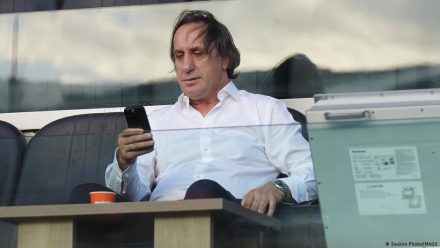
Iran’s supreme national security council confirmed the death of its chief, Ali Larijani, on Tuesday evening, after Israel said it had killed him in an airstrike. Larijani was the most senior Iranian figure killed since Iran’s Supreme Leader Ayatollah Ali Khamenei died in an Israeli strike on February 28.
Seen as one of the few people Khamenei trusted to help ensure the regime’s survival, Larijani emerged publicly about 24 hours after the United States and Israel launched war on Iran to denounce their actions. On national television and social media he vowed retaliation, saying, “We will burn their hearts. We will make the Zionist criminals and the shameless Americans regret their actions.”
Despite such fiery rhetoric, Larijani had an international reputation as a pragmatist. Over decades he combined a role as a ruthless powerbroker inside the regime with that of a competent negotiator in dealings with Russia, China and even the US.
Born in 1958, Larijani came from a prominent political-religious family long dubbed the “Kennedys of Iran.” His father was a grand ayatollah; brothers include Sadeq Ardeshir Larijani, who served as head of the judiciary, and Mohammad-Javad Larijani, a senior foreign policy figure and former adviser to Khamenei. His father-in-law, Morteza Motahhari, had been close to Ruhollah Khomeini. Though not a cleric himself, Larijani used these ties and his own career to rise through Iran’s system.
He joined the Islamic Revolutionary Guard Corps in 1981 and served as a commander during the Iran-Iraq war. He studied in a religious seminary before earning a degree in computer science and mathematics and then a master’s and doctorate in Western philosophy from the University of Tehran; his 1995 PhD focused on Immanuel Kant.
Larijani entered politics young, serving as culture minister in his mid-30s. In 1994 Ayatollah Khamenei appointed him head of Iran’s state broadcaster, a post he held for about a decade, during which the broadcaster was used as a pro-government tool—most notably in programs that branded dissident intellectuals as Western pawns. He ran for president in 2005 but received under 6% of the vote; hardliner Mahmoud Ahmadinejad won that election.
Larijani later became secretary-general of the Supreme National Security Council (SNSC) and Iran’s chief nuclear negotiator, resigning in 2007 amid tensions with Ahmadinejad. In 2008 he secured the speakership of parliament, a position he held for 12 years. As speaker he helped marshal legislative support for the 2015 JCPOA nuclear deal between Iran and six world powers, a pact that was later abandoned by the US under President Trump in 2018.
In 2020 Larijani was charged with overseeing a strategic 25-year cooperation agreement with China, finalized the next year and touted as projecting hundreds of billions in Chinese investment into Iran’s energy sector.
Larijani’s relationship with hardliners was often fraught. In 2021 the Guardian Council unexpectedly barred him from running for president. Reasons were not publicly given, but speculation ranged from concerns about family members abroad—his daughter was reported to live in the US and hold a British passport—to political motives clearing the way for the regime’s preferred candidate, Ebrahim Raisi. Ayatollah Sadiq Larijani publicly protested the disqualification as based on false intelligence. Analysts said Larijani’s open criticism of Raisi and the Revolutionary Guard and his restraint toward banned opposition figures contributed to his exclusion.
Raisi won the 2021 election but died in a 2024 helicopter crash. Larijani again attempted to run for president but was barred a second time; the 2024 election was won by moderate Masoud Pezeshkian.
In August 2025 President Pezeshkian reappointed Larijani as head of the Supreme National Security Council, returning him to top security leadership after a 12-day war with Israel. In the months that followed Larijani’s access to Khamenei and his public authority often appeared to overshadow the president’s. He played a central role in pushing renewed nuclear talks with the US and traveled repeatedly to Russia as a de facto envoy to Vladimir Putin, aided by close aides such as ambassador Kazem Jalali.
Shortly before the US and Israeli strikes, Larijani told Al Jazeera that Iran had used recent months to prepare for the possibility of war. “We found our weaknesses and fixed them,” he said. “We are not looking for war, and we won’t start the war. But if they force it on us, we will respond.”
This article was originally published on March 3, 2026, and was updated on March 17, 2026, with news of Ali Larijani’s death.
Edited by: Srinivas Mazumdaru