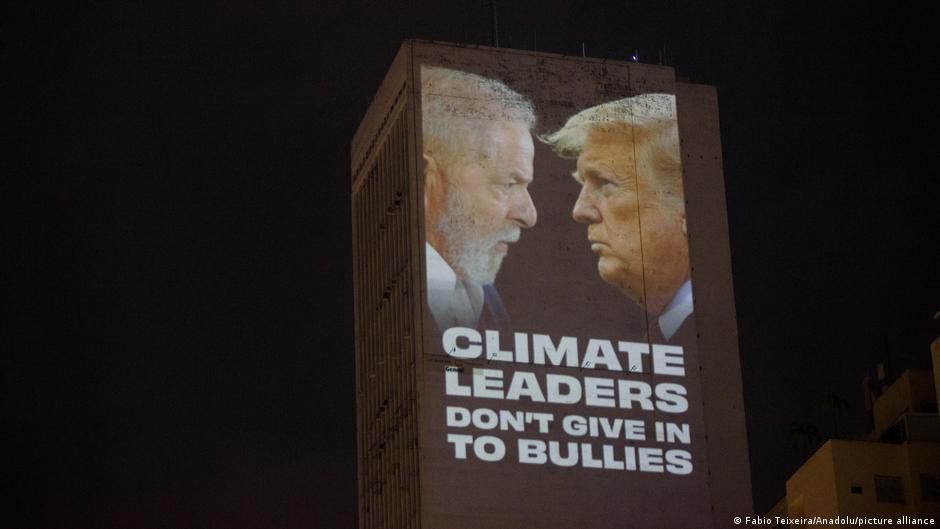

The Biden administration’s predecessor will not be represented by a top-level federal team at this year’s COP30 climate summit in Belém, Brazil. That absence was broadly expected given a president who twice pulled the United States from the Paris Agreement, cut renewable funding, backed fossil-fuel projects and once called climate change a hoax at the United Nations.
Still, a wide range of subnational and nonfederal actors from across the United States have stepped into the breach. Governors, mayors, tribal nations, businesses, universities and coalitions are traveling to Brazil to keep climate diplomacy and cooperation alive. Delegations from state and local networks together represent roughly two-thirds of Americans and nearly three-quarters of U.S. economic output.
“It’s a long way to come from Seattle to Rio, but I made the trip, and others made the trip, because it’s important for the rest of the world not to give up on the United States,” said Jay Inslee, the former Washington governor, while attending pre-COP events in Rio de Janeiro. Inslee is a founding member of the bipartisan US Climate Alliance, formed in 2017 in reaction to the first Trump administration; it now includes 23 states and one territory.
Inslee stressed that the country as a whole has not abandoned the Paris goals: “The United States have not pulled out of Paris. One part of the United States has, and that’s the federal government.” He added that state and city leaders will work to ensure a climate-skeptical White House does not create the impression that progress has stopped.
Observers caution, however, that Washington’s policies can still shape international dynamics from afar. Maha Rafi Atal, an associate professor of political economy at the University of Glasgow, warned that the administration’s tariff diplomacy could sway negotiations by pressuring trade partners seeking exemptions from measures such as the EU’s carbon border adjustment. “The signal sent to countries around the world is that the US may penalize in trade terms countries that take stronger climate action,” she said, potentially discouraging governments from prioritizing long-term emissions cuts over short-term growth.
Gina McCarthy, co-chair of America Is All In (AIAI), a coalition of local leaders and institutions, said federal policy can remain disruptive but stressed that local actors are pushing forward: “Our delegation is focused on what we know for sure: local leaders and businesses across the United States are pressing forward on clean energy and are eager to collaborate with international partners to strengthen the Paris Agreement.”
More than 100 subnational representatives from the US Climate Alliance, Climate Mayors and AIAI are taking part in COP30, which runs from November 10 to 21. While national governments make many formal decisions, state and city initiatives matter: the US is the world’s second-largest emitter after China, but subnational action can still move the country toward the Paris targets and a midcentury net-zero goal.
An analysis led by the University of Maryland’s Center for Global Sustainability for AIAI finds that stronger state and local measures, coupled with a restoration of federal support after 2028, could cut US greenhouse-gas emissions by 56% below 2005 levels by 2035. By comparison, the Biden administration had pledged reductions of up to 66% by 2035. The study highlights three priority areas for local policy: electricity, transportation and reducing methane from leaking gas infrastructure and organic waste.
“Our findings show that innovative local policies and market-driven clean technology investments can keep the US on a path toward significant emissions reductions, even in challenging times,” said Nate Hultman, director at the Center for Global Sustainability.
At the COP30 Local Leaders Forum, McCarthy — a former EPA administrator and Biden climate adviser — reiterated that “change happens from the bottom up.” She noted that the 24 states in the US Climate Alliance have cut emissions 24% below 2005 levels while growing their combined GDP 34%, a point used to argue that emissions reductions can coincide with economic growth and job creation.
Inslee highlighted those economic and employment benefits as central to the subnational push. He and others point out that renewables are expanding even in traditionally oil-heavy states: Texas, not part of the Climate Alliance and a state where voters have repeatedly backed Trump, leads the nation in renewable generation and battery capacity, in part because of demand for cheaper electricity. Recent data show average power prices in Texas among the lowest in the country.
Through their presence in Brazil, US state and local leaders aim to forge international partnerships and ensure subnational initiatives inform formal talks in Belém. “We have power, we have agency, we have authority, and damn it, we are going to use it!” McCarthy told supporters in Rio.