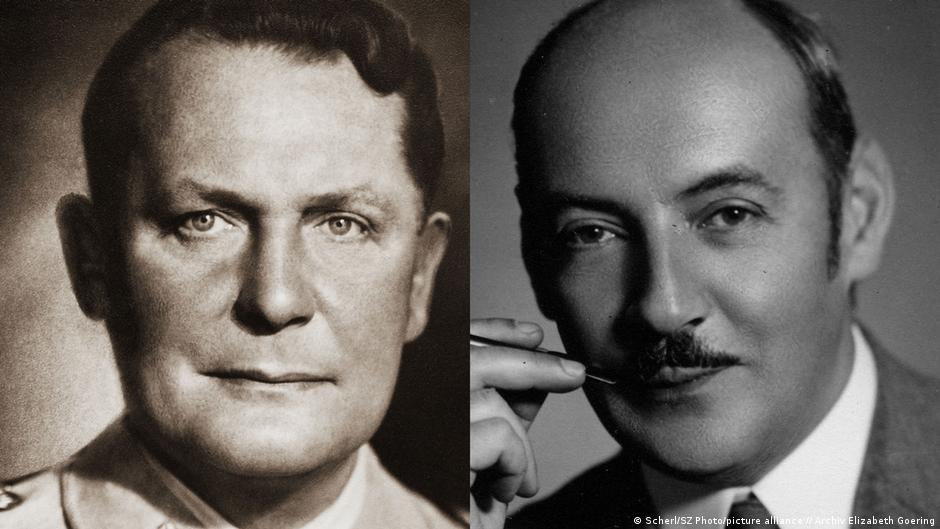

In March 1938, as SA paramilitaries paraded through Vienna to celebrate the Anschluss, an old woman was publicly humiliated when two SA men hung a placard reading “I am a Jewish pig” around her neck. A man pushed through the crowd to help her. He was beaten, arrested and briefly jailed — then released because of his name: Albert Göring, the younger brother of Hermann Göring, one of Hitler’s closest allies and the Luftwaffe’s commander. Where Hermann embraced power and Nazism, Albert quietly resisted.
The brothers could not have been more unlike one another. Hermann Göring was ambitious, narcissistic and an early, zealous supporter of Hitler. Albert trained as a mechanical engineer and worked as a technical director in the film industry in Vienna. He had no political ambitions, rejected Nazi ideology, and was described by contemporaries as a charming bon vivant who used his position and family connections to help people persecuted by the regime.
Albert’s interventions began in the cultural sphere. When the silent-film star Henny Porten lost work in Germany because she refused to abandon her Jewish husband, Hermann asked Albert to find her a role in Vienna. Later, when the Gestapo targeted Oskar Pilzer, a Jewish film producer and Albert’s former boss, Albert escorted Pilzer toward the Italian border to secure his escape. He also interceded for the composer Franz Lehár, persuading Hermann to register Lehár’s marriage as a “privileged mixed marriage,” a designation that shielded Lehár’s Jewish wife from deportation.
Beyond such appeals, Albert forged documents, organized escape routes, and provided funds to those fleeing persecution. His surname opened doors and could intimidate lower-ranking officials; his family tie repeatedly proved a life-saving asset. In 1939 he accepted a post as export director at the Škoda Works in Brno, then under German occupation. Some Czechs hoped that having a man with a direct line to a powerful Berlin relative might offer protection.
At Škoda, Albert used his position to aid the Czech resistance. He passed information on military sites and plans to anti-Nazi contacts, leveraging business ties and the access his role afforded. Eyewitnesses later recounted that he arranged for prisoners from Theresienstadt to be listed as “war-essential” workers at Škoda and then facilitated their escape when trucks were stopped in a forest. Such activities drew the Gestapo’s attention and led to Albert being declared an enemy of the state. Time and again, however, Hermann intervened to shield his brother. Biographers suggest that Hermann ranked himself first, then family, then fatherland, Nazism and Hitler — a hierarchy that helps explain why he protected Albert even when it became politically risky.
After the Third Reich collapsed, both Göring brothers were detained. Albert refused to denounce Hermann during interrogations and spoke of his brother’s “warm-heartedness,” an account that American investigators met with skepticism. To those who questioned him, the Göring name that had opened doors also made him suspect. US investigator Paul Kubala dismissed Albert’s testimony as self-serving. Albert produced a list of 34 people he said he had saved “at my own risk (three Gestapo arrest warrants!),” a roster that included prominent figures; nonetheless, no full, systematic verification of his claims was carried out at the time.
A change of interrogators helped Albert’s case. Victor Parker, who took over his file, was related to Sophie Lehár, one of the people Albert had assisted. Hermann Göring committed suicide the night before his scheduled execution; Albert was eventually released. But release did not mean vindication. In postwar Germany the Göring name made Albert a pariah. He struggled to find steady engineering work, survived on odd jobs and translations, and lived largely ostracized until his death in 1966 at age 71.
Interest in Albert’s story resurfaced decades later. Australian researcher William Hastings Burke, prompted by a television report, spent years in archives and interviewing associates and relatives of those Albert had aided. Burke published Thirty Four: The Key to Göring’s Last Secret, portraying Albert as a man who quietly opposed the regime without seeking public credit and arguing that his actions deserve recognition. Burke has nominated Albert Göring for Yad Vashem’s Righteous Among the Nations.
Albert Göring’s life exemplifies a stark moral divergence within a single family: one brother deeply implicated in the machinery of Nazi power, the other using his name and position to undermine that machinery and save lives, often at considerable personal risk. This article was originally written in German.