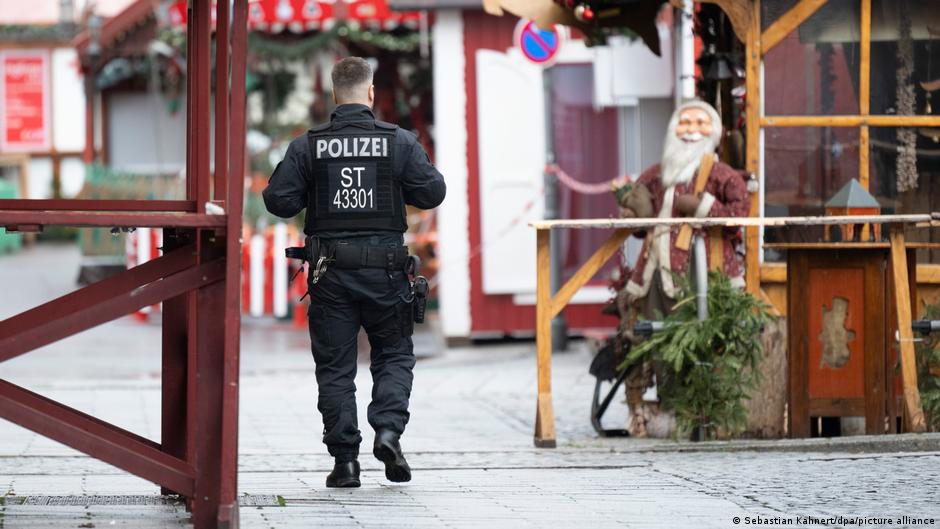

Shortly after 7 p.m. in December 2024 a man drove a rented car into a crowd at a Christmas market in Magdeburg, Saxony-Anhalt. The vehicle strike killed a 9-year-old boy and five women aged between 45 and 75. More than 300 people were injured, some seriously. Prosecutors say the entire attack lasted one minute and four seconds.
On Monday, 10 October 2025, the trial of the accused, identified in court papers as Taleb A.*, a 50-year-old Saudi national, opened at Magdeburg Regional Court. He is charged with murder, 338 counts of attempted murder and a so-called treacherous attack motivated by “base motives.” Prosecutors told the court they will seek the German legal equivalent of a first‑degree murder conviction.
Investigators say the indictment is based on the belief that he acted alone and planned and prepared the attack in detail over several weeks without accomplices. His background differs from Islamist attackers such as Anis Amri: Taleb A. has lived in Germany since 2006 and most recently worked as a physician in a forensic psychiatric unit for convicted offenders in Bernburg, about 40 kilometres south of Magdeburg.
A parliamentary investigating committee in Saxony-Anhalt has reported that the defendant suffered long‑standing health problems and is examining why the market lacked protective bollards, a security measure widely installed at many markets since the 2016 Breitscheidplatz attack in Berlin. Authorities say the defendant exploited that gap and drove through the crowd at speeds of up to 46 km/h (28.5 mph).
Media reports, citing an expert opinion from the Salam Center for Prevention of Violence and Radicalization, have described the incident as a planned act of terrorism. Other reporting says the defendant circulated large amounts of material from international right‑wing figures and conspiracy theorists about an alleged “Islamization of Europe” and was a sympathizer of the Alternative for Germany (AfD) party, which is under observation for right‑wing extremism. Security agencies had monitored the man: police carried out several Gefährderansprachen—that is, threat‑assessment conversations—in 2023 and 2024, but authorities concluded he could not be clearly assigned to a specific extremist category such as Islamist, right‑wing or left‑wing extremism.
Because of the large number of victims and parties involved, the court rented a newly built lightweight hall to accommodate participants. More than 140 people are registered as co‑plaintiffs and the prosecution has listed over 400 witnesses.
In July it became known that the defendant had written letters from his cell to injured survivors, addressing them by name and asking for forgiveness. Many recipients said receiving the letters retraumatized them. Investigators suspect the defendant obtained contact details from documents held by his defence lawyers.
On the first day of the trial Taleb A. did not answer the charges directly. Instead, the court said, he spoke at length—erratically, according to the presiding judge—about Saudi Arabia, what he called manipulated German media, Islamism, women’s rights and sex education, and accused the judiciary and police of corruption. After about an hour, presiding judge Dirk Sternberg interrupted him and adjourned the session until the following day.
Taleb A. has been in custody since the attack. If convicted, he faces life imprisonment for murder followed by preventive detention, a measure intended to protect the public after release and the most severe sanction under German criminal law.
This article was originally written in German. It was first published on November 10 and has been updated with observations from the court proceedings.
*Editor’s note: DW adheres to the German press code, which advises protecting the privacy of suspected criminals and victims by refraining from publishing full names.