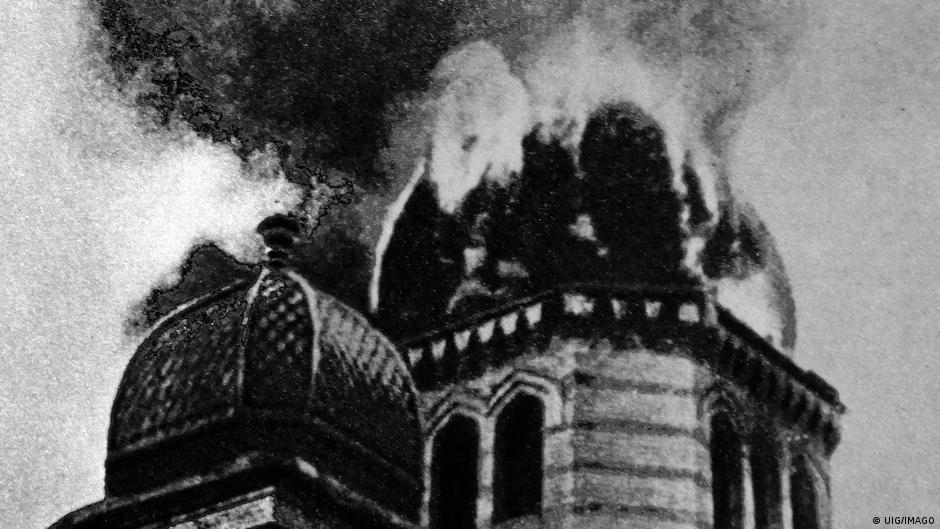

Words shape how people understand, remember and respond to events. The name used for the anti‑Jewish violence of November 9, 1938, matters because it frames what that night is seen to have been.
In Germany the episode has long been called Kristallnacht or Reichskristallnacht, usually translated as the Night of Broken Glass. The image of streets littered with shattered glass became a concise label for a countrywide eruption of terror. But many survivors, historians and Jewish groups argue that ‘broken glass’ softens the reality of what happened.
The United States Holocaust Memorial Museum counts hundreds killed and about 30,000 Jewish men arrested and sent to concentration camps. Rioters burned hundreds of synagogues and Jewish institutions across Germany and Austria, desecrated cemeteries, looted thousands of businesses, and then had the victims forced to pay for the damages. Meier Schwarz, a German‑born Holocaust survivor and Israeli academic, said the usual term obscures the atrocities committed against Jewish citizens.
Given that scale and the brutality involved, critics in Germany have increasingly preferred clearer, stronger language. Some favor the term pogrom, a Russian word meaning to demolish violently, and the compound Pogromnacht (night of pogroms) has gained use in German public discourse.
Outside Germany, however, Kristallnacht and its English equivalent remain common, used by media and institutions including the USHMM, which also describes the events as an organized, nationwide wave of violent anti‑Jewish pogroms. That dual usage — a traditional name alongside explicit description — reflects the tension between a familiar label and the need to convey the full horror.
Not all historians support swapping in pogrom. They note that pogroms historically covered a variety of violent anti‑Jewish outbreaks, especially in the Russian Empire, and that the assault under National Socialism had distinctive features: centralized coordination, state involvement and administrative follow‑through. Raphael Gross, president of the German Historical Museum, told public broadcaster DLF that the planning and coordination under the Nazis were ‘‘so special’’ and without comparison. Historian Friedemann Bedürftig dismissed replacing Kristallnacht with Pogromnacht as a Verschlimmbesserung — a misguided attempt to improve that actually makes things worse.
Language and historical interpretation change over time. How a society names past crimes reflects how it confronts them. The debate about Kristallnacht versus Pogromnacht is part of Germany’s ongoing effort to reckon with the Nazi past and to ensure public memory does justice to the victims and the facts.
Whatever term is used, scholars and public institutions emphasize clarity and accuracy. The point, as one museum director put it, is to know precisely what is being described: a coordinated, violent assault on Jewish communities that marked a decisive step toward the Holocaust.
Edited by Jon Shelton. Originally published November 9, 2023; republished November 9, 2025.