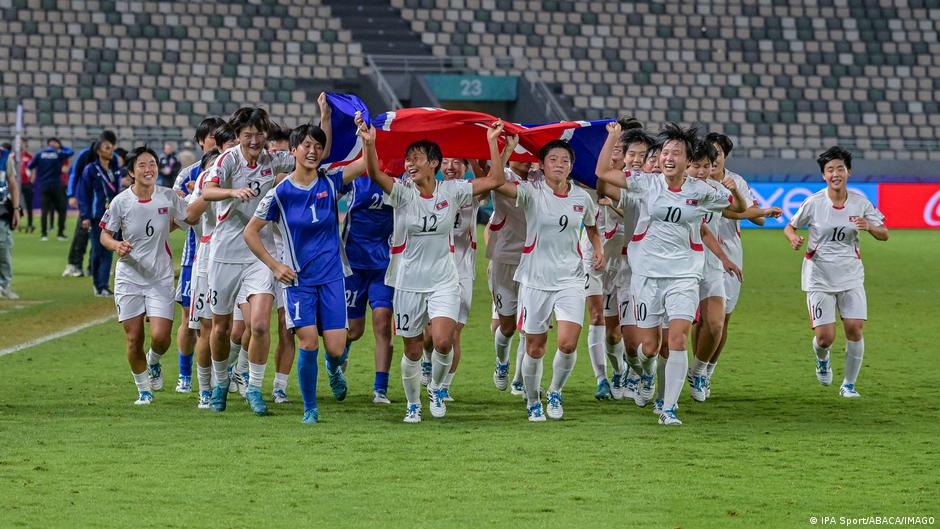

North Korea has emerged as the dominant force in women’s youth football. The country’s U-17 team claimed back-to-back World Cups, defeating the Netherlands 3-0 in Morocco — marking the fourth U-17 title for the nation — while the U-20 side secured its third World Cup in 2024. Together these results underline a deliberate and effective approach to elite youth development.
Experts say the success is partly political. Dr Jung Woo Lee, senior lecturer in Sport and Leisure Policy at the University of Edinburgh, tells DW that international sport is one of the few arenas where North Korea can assert its sovereignty and identity. High-profile victories allow the regime to display its flag abroad and to use sporting triumphs at home as propaganda that glorifies leaders and the state.
A focused, strategic program
North Korean authorities decided early on that breaking through at senior international level would be difficult. Instead they concentrated resources on women’s youth football, where the competitive gap is narrower and results come more quickly. Unlike many European systems — where professional club structures, multiple stakeholders and an emphasis on enjoyment shape youth pathways — North Korea channels girls as young as 13 or 14 into disciplined, systematic, and highly professional training environments. That intensity produces early technical and tactical advancement.
On the field, that approach shows up in tournament form. In Morocco the U-17s conceded only three goals across the entire competition and scored three or more goals in four matches. The U-20s’ 2024 run combined an emphatic 6-2 win over Argentina with a run of three consecutive 1-0 victories from the quarterfinals onward. The Pyongyang International Football School is central to this model, selecting, educating and developing players using a rigorous, quasi-scientific regimen.
Politics, ideology and incentives
Sporting achievement also serves an ideological purpose. Under Kim Jong Un, North Korea frames its athletes’ mental toughness and collective sacrifice as a demonstration of socialist superiority over capitalist systems that rely on market-based coaching and sports medicine. That narrative reinforces the regime’s broader messaging about resilience and national will.
Players are further motivated by concrete rewards. The state can offer advantages that are rare elsewhere in the country: residence permits for Pyongyang, apartments and other material benefits that transform players’ lives, especially for those from impoverished rural areas. For many talented girls, success on the pitch can feel like a life-altering opportunity.
Limits and opacity
High-performing individuals such as Yu Jong-hyang — top scorer at the 2025 U-17 World Cup — and Choe Il-son, important in both U-17 and U-20 title runs, have prompted speculation about potential moves to leagues like England’s WSL or the NWSL. In practice, transfers are complicated. International sanctions, state control over athletes, and past practices of governments routing players’ earnings through official accounts make foreign moves difficult.
Much about the teams and how the system operates remains opaque to outsiders, but the pattern is clear: a state-directed, results-oriented approach that prioritizes short- to medium-term international success in youth competitions. That strategy has delivered trophies and raised North Korea’s profile in women’s youth football, even as many longer-term questions — including the pathway to sustained senior success and the personal autonomy of players — remain unanswered.
Edited by: Chuck Penfold
This article was updated to reflect North Korea’s U-17 World Cup win in November 2025.