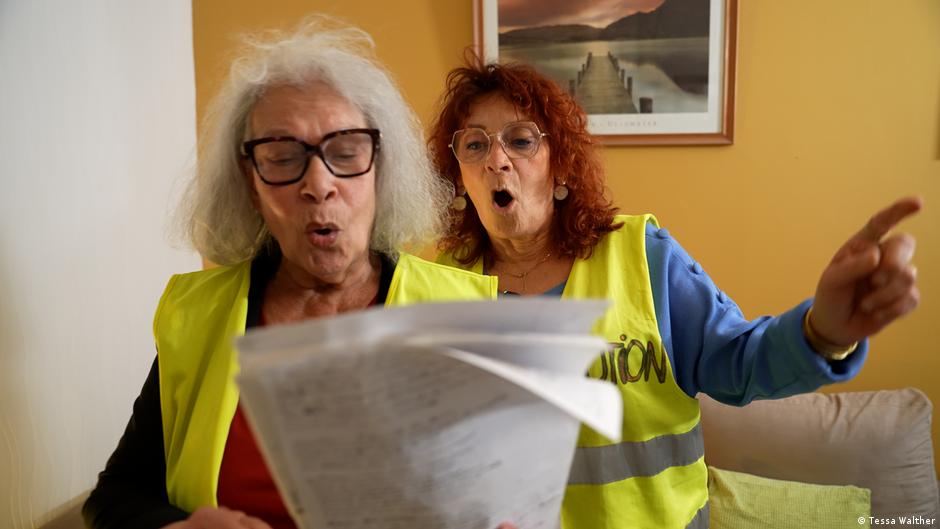

On a Sunday afternoon in a community hall in Lille, about 10 people gather for a theater rehearsal. Most are amateur actors who did not meet through the arts but in the ‘gilets jaunes’ or yellow vests protests that erupted in 2018–19, when demonstrators in high-visibility vests blocked roads to protest fuel taxes and the rising cost of living.
The nationwide movement has faded from its peak, though local actions persist and memories of shared anger and solidarity remain vivid. Sixty-six-year-old Marine Guilbert arrives at rehearsal with a yellow vest peeking from her backpack, painted with the words ‘fiere d’etre un gilet jaune’ and decorated with butterflies. A cleaner who earns less than €1,000 a month, Guilbert says she feels abandoned by the state and relies on family transfers and charity. On stage she channels that frustration. ‘We were born artists,’ she says.
The troupe was started by Anne-Sophie Bastin, a lawyer and former yellow vest from Lille. Troubled by the violence and clashes with police that accompanied the protests — incidents a Mediapart investigation tied to four deaths and hundreds of injuries — Bastin wanted to put those experiences into performance. She writes the scripts and directs the group. Their first production in 2019 focused on the yellow vests; their new piece, scheduled for late November in a 400-seat theater in Wasquehal, turns to the story of Bobby Sands, the Irish republican who died on hunger strike in 1981, a figure Bastin describes as inspiring.
Rehearsals bring a new dynamic for participants used to a leaderless movement. In street actions there was little hierarchy; in the theater they follow a director. Bastin sometimes steps in when actors improvise, reminding them, ‘It is me who wrote this script.’ The troupe has changed size and scope: once about 40 people when membership was limited to yellow vests, it later opened to friends and family and now counts roughly 15 members.
Outside the rehearsal room, France continues to wrestle with social and political tensions. A newer campaign, ‘bloquons tout’ (‘let’s block everything’), has drawn attention, and a mid-October Le Monde survey found 96% of respondents unhappy with the state of the country. Analysts point to structural issues — rising inequality, persistent poverty and a political system seen as ill-equipped to address them. Julien Talpin, a political scientist at the University of Lille, says anger is being expressed in nontraditional ways because the system no longer manages inequalities effectively.
Political instability compounds the problem. President Emmanuel Macron lacks a strong parliamentary majority to push through reforms aimed at boosting competitiveness and cutting deficits. National debt tops 100% of annual output, and past efforts to reduce deficits, including pension changes and proposals to limit holidays, have met fierce public opposition. France’s Inequality Observatory reports that poverty has risen over the last two decades. Experts warn that unseating Macron might not solve the deeper issues and could create space for the far-right National Rally.
In the Lille rehearsal room many members say they want Macron to resign, though some doubt a leadership change would immediately improve their lives. Pensioner Yolaine Jean Pierre, who writes protest songs, wears a badge showing a yellow vest and a red heart. When she sings, the others join in, their music directed at the president and carrying shared grievances. ‘We fight the same fight… We think the same. There is unity,’ she says.
For Guilbert, theater is a way to be heard. ‘I hope our voice is being heard on the ground and on the stage,’ she says, turning protest into performance and a renewed sense of community.