Accused Admits Driving in Magdeburg Market Attack

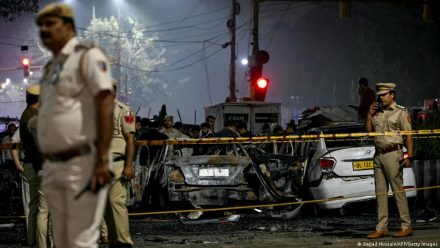
The man accused of killing six people by ramming a car into a crowd at a Christmas market in the eastern German city of Magdeburg last December said on Monday that he was the one behind the wheel during the incident. Shortly before his trial on 6 counts of murder and 338 counts of attempted murder broke for

AI-generated video of ‘crying 23-year-old’ is fake

"I've been mobilized, I'm heading to Chasiv Yar," says what appears to be a young Ukrainian soldier through floods of tears in the back of a military vehicle. "Help me, I don't want to die. I'm only 23. Please help me." A reverse image search using screenshots reveals that the video has been posted hundreds of times

Sarkozy Released from Prison Pending Appeal

A Paris appeals court on Monday decided to release former French President Nicolas Sarkozy from prison three weeks into a five-year sentence, and place him under judicial supervision. He left La Sante prison in Paris later Monday afternoon.  Earlier in the day, Sarkozy had described how his imprisonment was a "nightmare" as the appeal court examined his request for his release pending an

Temu and Shein Expand Across Europe Amid Rising Sales

When Chinese fast-fashion online retailer Shein opened its first boutique last week, there were both protests and a crowd of shoppers. The brick-and-mortar shop inside the BHV Marais department store in central Paris hit a nerve and not just because it is in the home of haute couture. It was a love-hate response to the

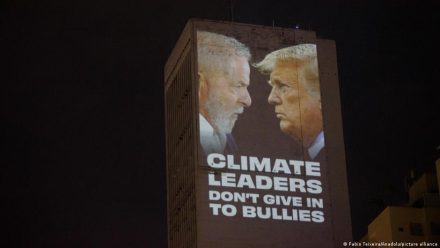
COP30 in Belém: Brazil’s Conference of Truth

Two cruise ships are bobbing quietly in the specially expanded port near the city of Belem in northern Brazil on the edge of the Amazon. They will serve as alternative accommodation for more than 10,000 participants at this year's climate conference.    Between 40,000 and 50,000 people, including heads of state and government from almost 200 countries

Is the AI Boom Facing a Reality Check?

The artificial intelligence (AI) party is still in full swing, with tens of billions globally pouring into infrastructure, startups and attracting the best talent. Among the headline announcements this year: ChatGPT parent company Open AI, Softbank and Oracle pledged to invest $500 billion (€433 billion) in AI supercomputers, Open AI and chip giant Nvidia announced a $100 billion fund

BBC chiefs resign over Trump documentary edit controversy

BBC Director General Tim Davie and head of news Deborah Turness resigned on Sunday after criticism of the way the United Kingdom's public broadcaster edited a speech by US President Donald Trump. The scandal is the latest to hit the BBC, which has also been accused of failing to maintain its political neutrality in its reporting of

NFL Returns to Berlin: History Meets Stadium Reality

On the day Berlin marked the 36th anniversary of the fall of the Berlin Wall, it was wild to watch the razzle dazzle of America's game on show in the German capital. The Indianapolis Colts beat the Atlanta Falcons 31-25 in overtime. Catching from the tortilla cannon, singing Country Road, watching Jonathan Taylor run 83-yards

Trial opens for Magdeburg Christmas market attack

A car as a weapon: That brought back memories of the attack by Anis Amri on the Christmas market at Berlin's Breitscheidplatz in 2016 and a similar attack by an Islamic extremist with a truck in the southern French city of Nice. In December 2024, a man drove a rented car into a crowd at a Christmas Market

{“title”:”November 1938 Pogroms Revealed Nazi Brutality”,”content”:”\”I can still clearly remember the morning of November 10,\” W. Michael Blumenthal recalled. \”My father was arrested early in the morning. Amid the commotion and despite the fact that my mother had forbidden me to do so, I went outside without being noticed. I saw the broken shop windows on Kurfürstendamm boulevard and smoke coming out of the synagogue on Fasanenstrasse.\” He was just 12 years old.\n\nThe Fasanenstrasse synagogue in Berlin was set alight on the night of November 9, 1938, and the image of burning synagogues and shattered storefronts quickly became the emblem of a coordinated, nationwide assault on Jews. That night and the days that followed saw roughly 1,300 synagogues and some 7,500 Jewish businesses destroyed; cemeteries, schools and homes were vandalized. Police largely stood aside as Jews were dragged into the streets, beaten and publicly humiliated. Fire brigades often refused to fight blazes in Jewish buildings, focusing instead on protecting \”Aryan\” properties.\n\nThe violence intensified on November 10, when about 30,000 Jewish men were arrested and sent to concentration camps including Dachau, Sachsenhausen and Buchenwald. Blumenthal\u2019s father was among those taken. Blumenthal remembered his mother\u2019s desperate questions as he was marched away: \”What’s going on? What are you doing with him? What has he done? Where is he being taken to?\” Even at 12, he felt the adults’ fear.\n\nBlumenthal’s family escaped to Shanghai in 1939, one of the few destinations then admitting Jewish refugees without visas. He later described his experience in his memoir From Exile to Washington: A Memoir of Leadership in the Twentieth Century.\n\nThe attack did not come from nowhere. Anti-Jewish persecution had been official policy since the Nazis took power in 1933. The Nuremberg Laws of 1935 legally defined Jews and imposed sweeping professional and social bans, and the program of \”Aryanization\” had already dispossessed many Jewish businesses and property. Still, historians mark November 1938 as a decisive break: the era of German Jewry as it had existed effectively ended, and German society was changed irreversibly.\n\nThe immediate pretext for the pogroms was the assassination on November 7, 1938, in Paris of German diplomat Ernst vom Rath by Herschel Grynszpan, a Jewish teenager. Within hours of German radio reporting the killing, anti-Jewish riots erupted in some cities; two days later, after orders from the Nazi leadership, the violence was organized and intensified. At a gathering in Munich for the anniversary of the Beer Hall Putsch, propaganda chief Joseph Goebbels drafted directives that called for the destruction of Jewish businesses and synagogues. Police were told not to intervene, firefighters were instructed to protect only non-Jewish buildings, and looting was officially prohibited even as theft nevertheless occurred.\n\nOfficials’ instructions were carried out across Berlin, Cologne, Hamburg, Frankfurt and hundreds of smaller towns and villages. Many Germans either joined the attacks or watched without intervening. \”The November 1938 pogrom was carried out in plain sight,\” said Raphael Gross, president of the Deutsches Historisches Museum. \”It could be seen by everyone \u2014 the press of the world, foreign diplomats and all citizens.\”\n\nDiplomats in Germany reported scenes of \”cultural barbarism\” and widespread looting; some accounts were especially brutal. Reports collected by Hermann Simon, former director of the Centrum Judaicum, included the Polish consul general in Leipzig describing a woman stripped and nearly raped, the Latvian ambassador likening Kurfurstendamm to a battlefield, and the Finnish envoy noting pervasive shame and condemnation among the German population. Governments received these dispatches, but most took only limited action. A small number of concrete responses did follow: for example, the Kindertransport to England began after November 1938, bringing many children to safety. But by and large international reactions were inadequate.\n\nFew at the time predicted the scope of what would come. In a stark misjudgment, the Italian embassy wrote on November 16, 1938, that it was inconceivable Germany would one day send hundreds of thousands to execution or confine them in massive camps.\n\nHistorians today regard the events of November 9, 1938, as a turning point that revealed the regime’s readiness for widespread, state-condoned violence against Jews. Because the old term \”Kristallnacht\” is now seen as trivializing, the events are more accurately referred to as the Reichspogromnacht or the November Pogroms.\n\nThis piece is a rewritten account of reporting originally published in German and previously adapted in English.”]}

"I can still clearly remember the morning of November 10," said W. Michael Blumenthal. "My father was arrested early in the morning. Amid the commotion and despite the fact that my mother had forbidden me to do so, I went outside without being noticed. I saw the broken shop windows on Kurfürstendamm boulevard and smoke
back to top