Roman's Wide Field Is Aimed at the Universe's Least-Understood Components
Dark matter and dark energy make up most of the universe and are known almost entirely by inference. Roman's survey design is built to constrain both.
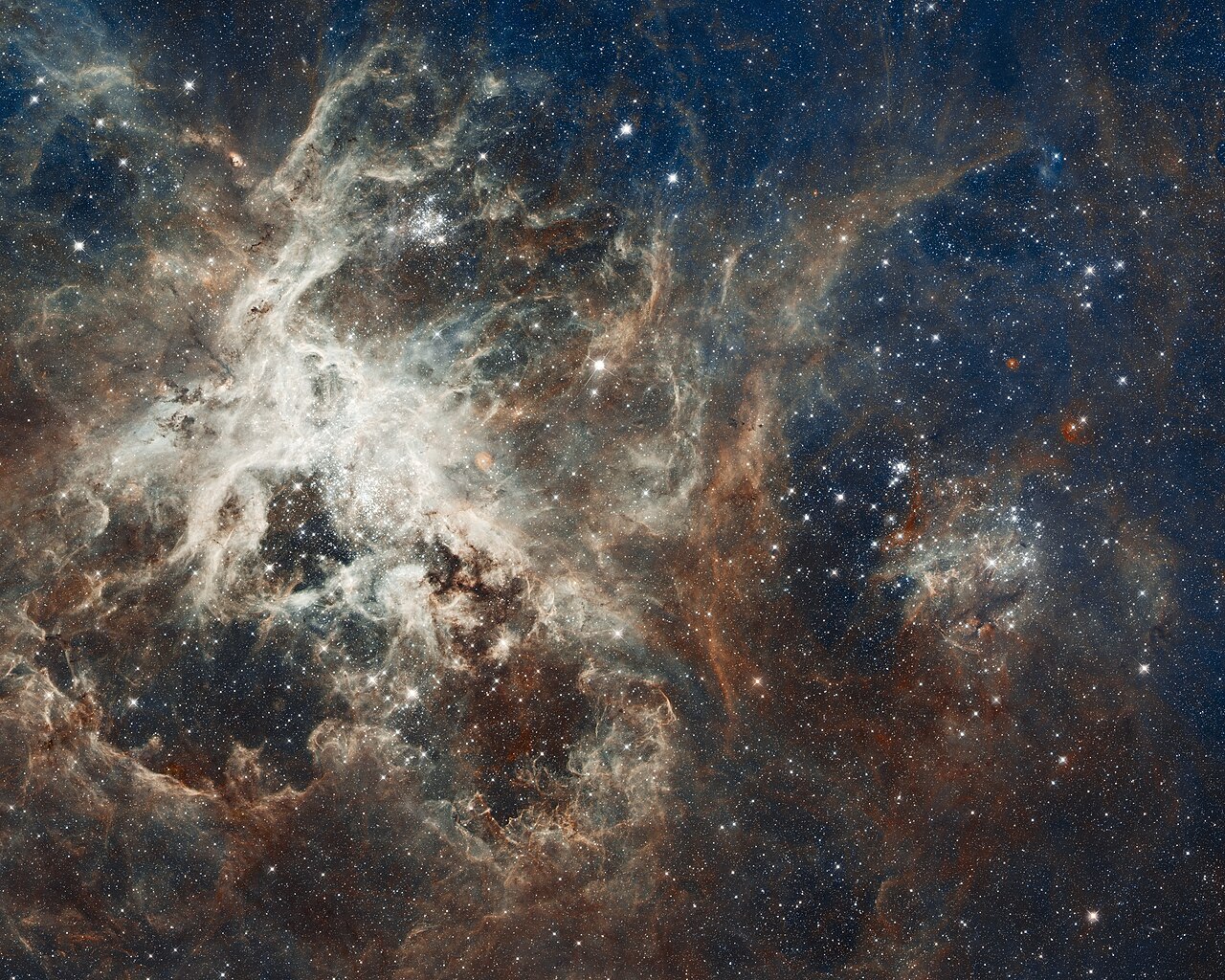
NASA's newly launched Roman Space Telescope will address nearly every area of astrophysics, but the questions shaping its design are the two least understood: dark matter and dark energy.
What is actually known
Ordinary matter — everything in every star, planet and person — accounts for a small fraction of the universe's contents. The rest is divided between dark matter and dark energy, and neither has been directly detected.
Dark matter is inferred from gravity. Galaxies rotate faster than their visible mass allows, and light bends around galaxy clusters more than it should. Something with mass is present that does not interact with light.
Dark energy is inferred from expansion. The universe's expansion is accelerating rather than slowing under gravity, which requires something pushing outward.
Both are placeholders — names for observed effects, not descriptions of substances.
Why a wide field is the right instrument
Neither can be studied by pointing at an object, because neither has objects to point at. They are studied statistically, across enormous volumes:
- Weak gravitational lensing — measuring subtle distortions in the shapes of millions of galaxies to map intervening mass.
- Expansion history — measuring distances and recession velocities across cosmic time to determine how acceleration has changed.
Both require large samples. Roman keeps Hubble-class optical quality while seeing a far wider area at once, which is what makes surveys of the necessary scale possible within a mission lifetime.
Exoplanets, by a different method
Roman will also detect planets through microlensing — brief brightenings when a foreground object's gravity focuses light from a background star.
Microlensing is sensitive to planets that other techniques miss, including those on wide orbits and those bound to no star at all. It also requires monitoring vast numbers of stars continuously, because the events are rare and unrepeatable. Another survey problem.
What success looks like
Not a discovery announcement. Roman's contribution will be constraints — narrowing the range of models that remain consistent with observation.
Ruling things out is how this kind of physics advances, and it is considerably less satisfying to report than a detection would be.